
Plants
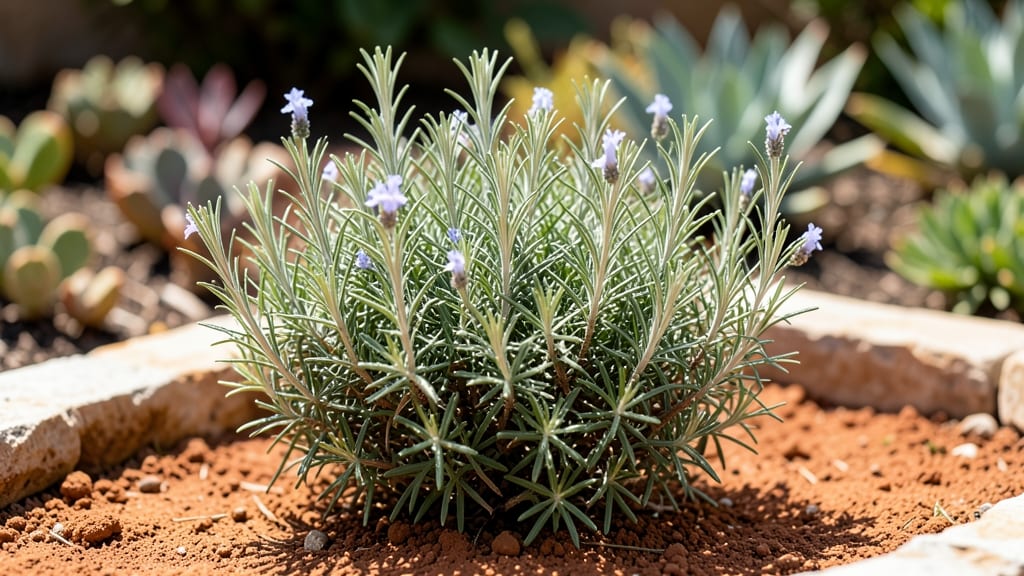
A rosemary bush looks like an upright, woody perennial with needle-like, aromatic green leaves, slender stems, and small purple, white, or blue flowers that bloom in spring. Its silvery-green foliage grows in clusters along rigid branches, reaching 2 to 6 feet tall depending on the variety.
A rosemary bush's most distinctive feature is its aromatic, needle-like leaves that grow in pairs along square stems, giving it a unique texture unlike other herbs. 🌿 The leaves release a piney scent when crushed, and the plant's upright, bushy growth habit makes it stand out in gardens.
In warmer months, you'll spot delicate flower spikes in shades of purple, white, or blue, adding a pretty contrast to the silvery foliage.
What sets rosemary apart from similar herbs like thyme or oregano is its woodier, more rigid structure—it never flops over like thyme, and its leaves are much longer and sharper. The flowers also grow in clusters at the tips of branches, rather than scattered like oregano's blooms.
In colder climates, rosemary may go dormant in winter, but its woody stems often remain visible, making identification easier even when leaves are sparse.
💡 In This Article
- Rosemary Leaf and Stem Characteristics
- Identifying Rosemary by Growth Habit and Flowers
Rosemary leaf and stem characteristics
Rosemary leaves are actually small, needle-like structures called needle leaves or linear leaves, measuring about 1/2 to 1 inch long and 1/16 to 1/8 inch wide.
Unlike flat leaves, they have a unique cylindrical shape that rolls slightly at the edges, giving them a slightly rough texture when rubbed between fingers. This shape helps reduce water loss in their Mediterranean native habitat, where drought is common.
The leaves grow in opposite pairs along the stems, creating a symmetrical pattern that's easy to spot. Each pair is attached by a short petiole (leaf stalk) to the square-shaped stems, which are another key identifier.
These stems have four distinct ridges—like a tiny square column—that give the plant its signature woody, rigid structure. When crushed, both leaves and stems release that familiar piney-camphor scent, a result of essential oils like camphor, eucalyptol, and borneol that act as natural insect repellents.
What truly sets rosemary apart from thyme or oregano is how its leaves attach to the stems. Thyme leaves grow in whorls of three and are much smaller (1/8 inch long), while oregano leaves are broader and oval-shaped, growing opposite but with a softer texture.
Rosemary's leaves also have a leathery quality when mature, feeling slightly thicker than other culinary herbs. This durability helps them survive harsh conditions, which is why rosemary thrives in poor, rocky soils where many plants would struggle.
The stems deserve special attention too. Young rosemary stems are green but develop a brownish-gray bark as they mature, creating a striking contrast with the bright green leaves.
These woody stems can become quite thick—up to 1/4 inch in diameter—and remain upright even when the plant is several years old. This rigidity comes from a unique internal structure where the vascular bundles (water-transporting tissues) are arranged in a circular pattern, providing extra strength against wind and drought.
Here's a quick comparison to help you distinguish rosemary from similar herbs:
- Rosemary: Needle-like leaves in opposite pairs, square stems, 1/2 to 1 inch long leaves, woody and rigid
- Thyme: Tiny oval leaves in whorls of three, round stems, 1/8 inch long leaves, soft and sprawling
- Oregano: Broad oval leaves opposite on stems, round stems, 1/4 to 1/2 inch long leaves, tender and bushy
The scent test is foolproof: crush a leaf between your fingers—rosemary's aroma is strongly pine-like with a hint of camphor, while thyme smells more like mint and oregano has a warm, slightly bitter herbal scent. 🌿