
Size
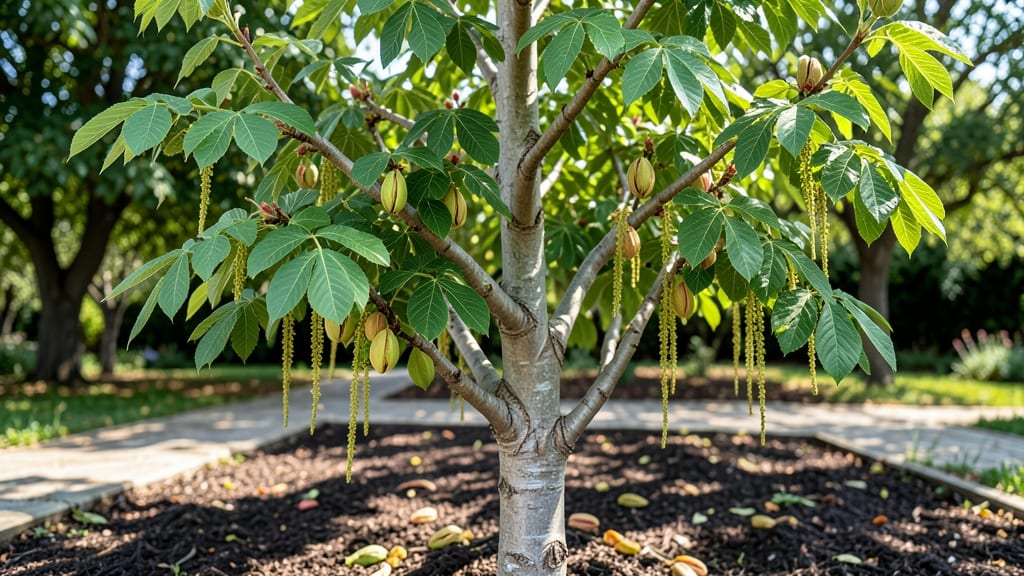
Pistachios grow on pistachio trees, not bushes, because they belong to the Pistacia vera species—a tall, deciduous tree that can reach heights of 10-30 feet and requires both male and female flowers for pollination.
These nut-bearing trees thrive in warm climates and have a unique growth pattern where female flowers produce the iconic green-hulled nuts we eat. 🌳 Unlike shrubs, pistachio trees develop a strong central trunk and sprawling branches, which is why commercial orchards space them 20-30 feet apart for proper air circulation and sunlight exposure.
The tree's deep root system also makes it more drought-resistant than many other nut-producing plants.
What's interesting is that pistachio trees aren't self-pollinating—you'll need at least one male tree for every five female trees to ensure proper fruit set. This botanical quirk explains why commercial groves often plant them in specific ratios.
For home gardeners, this means you'll need to plan your orchard carefully if you want a successful harvest.
💡 In This Article
- Pistachio Tree Botany: Why They’re Trees, Not Bushes
- Growing Pistachio Trees at Home: Key Cultivation Tips
Pistachio tree botany: why they’re trees, not bushes
The Pistacia vera tree belongs to the cashew family (Anacardiaceae) and is classified as a deciduous species, meaning it sheds its leaves annually in cooler months. This growth habit contrasts sharply with shrubs, which typically maintain foliage year-round or have much shorter, multi-stemmed structures.
Pistachio trees develop a single, dominant trunk that can grow 10-30 feet tall with a spread of 15-25 feet, forming a broad canopy that provides shade and optimal conditions for nut production.
The tree's root system is another key differentiator—pistachios develop deep, extensive roots that can reach 6-10 feet underground, allowing them to access water deep within the soil. This adaptation explains their remarkable drought tolerance compared to bush-like plants.
The bark is thick and rough, developing deep fissures as the tree matures, while younger trees have smoother, lighter-colored bark that gradually darkens with age. 🌳 The tree's structure also includes sprawling lateral branches that create an open, airy canopy—critical for preventing fungal diseases that thrive in dense foliage.
What makes pistachio trees so efficient at nut production is their biennial bearing pattern, where heavy crops alternate with lighter years. This cycle is tied to the tree's energy allocation between growth and fruit production.
Female flowers (which produce nuts) develop in clusters along the branches, while male flowers (needed for pollination) grow on separate trees.
This dioecious nature means you'll always need both male and female trees in proximity for successful fertilization—a process that occurs when wind carries pollen from male flowers to female ones during spring blooming.
Commercial orchards leverage this biology by planting trees in specific ratios—typically 1 male tree for every 5-10 female trees—to ensure optimal pollination. The tree's height also plays a role in this strategy: taller trees allow pollen to disperse more effectively over larger areas.
In contrast, bush-like plants would struggle to achieve this same level of cross-pollination due to their limited vertical reach and denser growth habit. The tree's size also makes it easier for workers to harvest nuts using mechanical shakers that dislodge them from branches.
One fascinating botanical detail is how pistachio trees self-prune—dropping older branches naturally to redirect energy toward younger, more productive growth. This process creates an open structure that improves air circulation and sunlight penetration, both critical for preventing disease and maximizing nut development.
The tree's ability to grow so large also means it can store more nutrients in its trunk and roots, supporting the energy demands of producing 50-100 pounds of nuts per tree annually in ideal conditions.
For comparison, consider how bush-like plants (like blueberries) produce fruit along multiple stems close to the ground, whereas pistachio trees concentrate their fruiting on the upper branches.
This vertical growth strategy allows pistachio trees to outcompete weeds and access more sunlight, which is why they're cultivated as trees rather than managed as shrubs.
The tree's size also makes it more resilient to environmental stressors like wind and temperature fluctuations, which could easily damage a more delicate bush structure.